Mobil Keluarga Ideal Terbaik Indonesia
Mobil Keluarga Ideal Terbaik Indonesia.....Saat ditanya tentang “Apa mobil idaman anda?” tentu jawabannya berbeda-b
 eda sesuai dengan latar belakang penjawabnya. Misalkan seorang yang memiliki latar belakang bidang teknologi akan menjawab mobil yang bisa terbang, ada pula yang menjawab mobil yang bisa jalan sendiri sesuai perintah kita di komputer. Orang yang berlatar belakang ekonom pun akan menjawab mobil yang gratis tapi bagus adalah mobil idaman semua orang karena utnuk memperolehnya tanpa perlu pengorbanan. Jawab-jawaban diatas saya peroleh dari sedikit wawancara saya dengan teman-teman saya dengan latar belakang yang berbeda.
- Mobil : adalah kendaraan bermotor dengan roda berjumlah empat, mampu menampung minimal 1 orang. Yang pasti memiliki harga lebih mahal dari kendaraan darat lainnya (he he he…)
- Keluarga : sekecil kecilnya keluarga berjumlah 2 orang tersiri dari pasangan suami istri. Apabila di hubungkan dengan mobil jadi mobilnya harus mampu menampung minimal 2 orang. Bisa juga 3 orang, 4 orang.
- Ideal : utnuk mengartikan mobil ideal ini tentu relatif tergantung dari sudut mana membahasnya. Dalam kesempatan kali ini karena ada kata kunci Indonesia maka kita ambil rata-rata kemampuan rakyat Indonesia dalam membeli mobil, selera pembeli. Maka kita akan mengambil garis tengahnya. Menurut pengamatan hasilnya ada 5 poin :
- Kenyamanan
- Terbaik : paling baik diantar semua produsen mobil memiki keunggulan-keunggulan yang mampu menjawab keluhan-keluhan konsumen mobil Indonesia
- Indonesia : berarti mobilnya harus disesuaikan dengan kondisi Indonesia sa at ini, bagaimana jalannya, bagaimana iklimnya dll.

The five-minute tofu recipe people who hate tofu LOVE

It is as tasty as chips, can be as salty as chips, is nearly as crunchy as chips, and is almost as easy to make as opening a bag of chips.
And it is something like a million percent healthier and a million percent less fattening. Which means if you are trying to diet or trying to eat healthy foods, this is the chip for you.
The invention of the tofu chip
I was making a curry tofu for myself and my curry-addicted husband ("Add more curry." "No, if I add more curry I won't be able to feel my extremities." "Yes, YES, add that much more." Sigh.) when I realized I had too much tofu.
What to do with leftover tofu?
It was too little to put back in the fridge, too much to throw away, but the perfect amount to screw around with.
So I did. And, inspired by salt and pepper tofu from the Chinese restaurant down the street, I invented tofu chips.
Vegetarian recipe for delicious tofu chips, if I do say so myself
1 package of very firm tofu (it's got to be the really firm stuff)
oil
salt
pepper
Place your tofu in a colander in the sink for at least an hour to allow the liquid to drain. Place a clean tea towel on top. Don't have an hour? Then pat your tofu firmly with the towel to soak up as much liquid as possible (I've done this when I was rushed and it works just fine).
Slice your tofu thinly (think the width of thick potato chips) and place your saute pan on the burner. Turn the heat to medium. When the pan is warm (you can tell when you drizzle a few drops of water into the pan with your fingertips and they instantly dance), add enough oil to generously coat the bottom of your pan.
Add your tofu (do not overlap; if your pan is too small to fit all the tofu, then do this in stages) and generously salt and pepper your slices (or use any other spices you like "Such as curry?" "No, haven't you had enough curry?" "Never!").
When the tofu has browned and crisped (it takes only a few minutes, but the trick is not to fuss with your tofu), then flip and salt and pepper yet again.
Cook until the other side is equally brown and crisp.
Pile onto a plate and munch away. Or arrange on a platter with dip and vegetables and munch away. Or dump them into a bowl and sneak into the den and enjoy them before your curry-loving husband wanders in to see what you are cooking and if it would be better with the addition of, say, curry.
The world's best cookie recipe
 I don't make cookies. Sure, I'll eat a cookie if one is given to me (and I've never met a black and white cookie I could refuse). But I don't crave cookies.
So if I tell you I've got the world's best cookie recipe, then you know I am not kidding.
The world's best cookie recipe
This recipe is from Pot on the Fire: Further Exploits of a Renegade Cook by John Thorne, Matt Lewis Thorne). I'm a massive fan of theirs (not only are the recipes wonderful, but he writes like a dream) and I highly recommend all their books as well as their wonderful newsletter.
They say this is the world's best cookie recipe. If you try this recipe, I'd like to know what you think.
(By the way, while this is vegetarian, it is not vegan - certainly not with that dairy in there - so only make these for your vegetarian friends!)
Vegetarian recipe for the world's best cookies: Arnhem Cookies
1 1/2 cups (7.5 ounces) all-purpose flour
1/2 cup plus 1 tablespoon (4.5 ounces) whole milk (see footnote #1)
1/8 teaspoon freshly squeezed lemon juice
1/3 of a standard .6-ounce cube of fresh yeast or 1 scant teaspoon of dry yeast
1/8 teaspoon salt
1 stick (4 ounces) unsalted butter, cut into 8 cubes
about 1 cup crushed rock sugar or sugar crystals (see footnote #2)
A heavy-duty electric mixer fitted with a dough paddle or a food processor fitted with a plastic blade.
The cookie dough should be prepared several hours ahead of the time you plan to make the cookies.
Combine the flour, milk, lemon juice, yeast (crumbling it into the mixture, if fresh), and salt into the bowl of the mixer or processor. Turn the machine onto high. As soon as the contents of the bowl are well mixed, add the first cube of butter. Beat this into the mixture for 1 minute, then add the next cube, beating this into the mixture for 1 minute. Continue in the same way until all the butter has been amalgamated. The dough will be soft and elastic to the touch. Use a spatula or dough scraper to form it into a ball. Place it on a plate, cover it with a bowl, and set it in the refrigerator until cool, or about two hours. If you wish, you may leave it overnight.
When ready to make the cookies, preheat the oven to 275 F and line two standard cookie sheets with parchment paper.(see footnote #3)
Sprinkle the work surface on which you plan to roll out the dough with a coating of sugar crystals. Uncover the dough and, with a sharp kitchen knife, divide it in half. Form each half into a round ball.
Coat the first ball of dough thickly with sugar crystals and transfer it to the sugared working surface. There, use a rolling pin to gently roll it out as thinly as possible, pausing frequently to sprinkle it and the counter with more sugar crystals. Also, while this is still possible, periodically turn the dough over so that more sugar crystals can be sprinkled on the bottom surface. The thinner and more evenly the dough is rolled, the better (and more authentic) the cookies; it should be almost as thin as homemade egg noodle dough.
If you wish, use a cookie cutter to cut the dough into ovals, the traditional shape. Otherwise, use a pizza cutter or sharp utility knife to cut them into rectangles, roughly 1 by 2 inches. Set the formed cookies into one of the parchment-lined cookie pans and place this into the preheated oven. The cookies should be baked until their tops are caramel-colored and their bottoms a crisp brown. Dahl's time is 30 to 45 minutes; we used insulated cookie pans, and our baking time was closer to an hour. While these bake, roll out and form the second batch of cookies in the same way.
Remove the baked cookies from the oven and-taking care with the hot pan-slide the parchment paper and cookies onto a wire cooling rack. Remove them from the paper as soon as they are cool enough to handle (see footnote #4). They keep well for at least for a week in an airtight container-but are best eaten within the first two or three days.
Footnotes
1 - The exact amount will depend on your flour. If your mixer struggles with the dough, dribble in more milk.
2 - Dahl writes that his own Arnhems were not quite as good as the real thing. This may be because his recipe substitutes crushed sugar cubes for the Dutch kandij suiker, amber crystals better known in this country as coffee sugar crystals. We used Billington's Amber Crystal Sugar, which is the ideal size-like fine gravel. But any amber coffee crystals will work well-larger ones should be crushed down to size with a rolling pin.
3 - Don't substitute the new Teflon baking mats for parchment paper; these don't work nearly as well.
4 - If your cookies have puffed up and have a chewy rather than crisp texture, they weren't rolled thin enough. They'll be good, but you won't think them contenders for the world's best cookies.
Tips from culinary school: How to cook rice, pilaf, pasta, potatoes perfectly

I promised to post some of the good tips I learned from the chef's here.
So I thought I'd start with tips on how to cook rice, pilaf, pasta, and potatoes to perfection. These are the insiders' tricks you wished someone had told you years ago.
Well, now someone has!
Rice me up, Scotty
The first starch we learned about was white rice. And the recipe for it could not be simpler: 1 cup rice + 2 cups water.
Here’s how you cook it. First, rinse the rice. Pour off the water. Be horrified at the dirt in the water. Rinse again, if needed. Put the now clean rice and a matching amount of water into your pot. Bring to a boil. Put a lid on your pot, and then (and pay attention class, this is the first of a series of brilliant tips) pour some cold water onto your lid.
That cold water does two things. First, when the steam inside the pot hits the lid, the cold water on the outside makes it rain back down on the rice. Second, an easy way to tell when your rice is ready is to watch that cold water. When it is evaporated, you know your rice is done.
Not sure? Peek into your pot. See wells in the rice? Yep, it’s done.
Now, don’t go stabbing your big wooden spoon in there, crushing all your nice grains of rice (like I, ahem, used to do, oh dear). Instead, take a spatula and run it around the edge of your pot, turning your rice gently over into the center, giving it a soft stir as you go. See, lovely taste and lovely texture.
Next, let’s meet polenta
There is only one trick to polenta: Stir, stir, stir.
Wanna try your hand? Then the formula is as easy as the rice formula, only, in this case, it is 1 cup polenta + 3 cups water + more water as needed.
No lid; no cold water. Just rinse (might as well rinse all your grains before you use ‘em, what can it hurt?) bring to the boil, don’t forget to stir, lower to simmering, and, did I mention you needed to stir until it is done?
See, I told you that was easy.
Let me introduce pilaf, Edith Pilaf
Dreadful joke. So sorry. But read on if you want to pilaf.
Beyond your grain and your liquid, you only need three things for a successful pilaf:
- fat
- aromatics
- herbs / spices
The grain can be anything from rice to barley. The liquid, anything from chicken stock to water. You decide.
Here’s how we made it. First, we heated the pans. Then, we added the fat. In this case, it was butter. The Nepal chef made us all listen to the sizzle of the butter. “See,” he said. “It is singing.” And it was.
Next, we added the aromatics which, in our case, was minced onion which we sweated at low heat. Then we added water and herbs. For herbs, we used a bay leaf and a sprig of thyme. On with the lid and into a 350 degree Fahrenheit oven and 20 minutes later we were all singing (so sorry) the praises of pilaf.
The best homemade pasta tips, ever
- Pasta tip number one: The trick with pasta is to use as little oil as possible. See, oil is a shortening. Shortening because it shortens strands of gluten in your flour. This, in turn, will make your dough tough. Great in bread, yes, but not in a nice, soft pasta.
- Pasta tip number two: If you want to make a long strand of pasta but you don’t have the elbow room those TV chef’s have, thread your pasta partway through your machine and stick one end of your pasta to the other end (think that classic picture of the snake eating it’s own tail). You keep feeding your loop round and round without having to deal with an unwieldy long strand. Brilliant, yes? Indeed, yes.
One potato, two potato, three potato, four
As an interesting demonstration, the chef made peeled and cubed potatoes boiled in water, whole potatoes boiled in their skins, and baked potatoes baked in their skin. Then she removed the skins from any potatoes that had ‘em, and ran each of the potatoes through a food mill, so she ended up with three piles: One per cooking method.
The cubed potatoes had, as you can guess, lots of water, making them mushy and unable to hold any yummy butter (assuming you wanted to add butter, and why wouldn’t you, I ask?). The whole boiled potatoes fared better - held less liquid - but the best potatoes, by far, where the baked ones: Dry and fluffy and waiting to absorb as much butter as you wanted to add. Yum yum.
See. Great tips, eh? I've got a million more on Cooking School Confidential. In fact, my goal is to write about 'em whenever I can remember 'em. So we can all benefit.
It's like you're going to culinary school with me!
Featurettes Soul Food Nation

Bring on the braised greens! Soul food—healthy, sustainable, soul food—has arrived, thanks to chef and cookbook author Bryant Terry.
By Elizabeth Castoria
If the first thing that comes to mind when you hear the phrase “soul food” isn’t sustainable agriculture with a side of social justice, you clearly haven’t met Bryant Terry. The 35-year-old activist (and Aquarius, as he quickly points out) is on the brink of making soul food synonymous with healthy living and stable, fair food systems. Though Terry says the food-justice movement has come a long way, there’s still a long way to go for those who want to see a healthy, nourished nation with equal access to fresh produce. In working toward that goal, Terry’s been featured on the Sundance Channel’s “Big Id
VegNews: Are you a vegetarian?
Bryant Terry: I became a vegetarian in high school. Then a vegan. Then a fruitarian for a summer in college. Then a breathatarian for a day. Then a pescetarian in graduate school. Then back to being a vegan ... As one can tell, my relationship with food has been fluid, shifting as I have changed. So I choose not to label my diet at all, nowadays. But if I were to characterize it, I would say that I have a plant-centered diet devoid of meat.
VN: How has food justice changed since you first became involved?
BT: It has moved from the margin closer to the center.
VN: What’s been your proudest moment as an activist?
BT: When I stopped being dogmatic, self-righteous, and judgmental.
VN: Have you been able to convince your family members—who you’ve said inspired you to focus your work in the South—to eat more healthfully?
BT: I have convinced many of my family members in the South to eat more of the fresh, seasonal, and sustainable foods that they grew up eating. It’s about helping them remember, not teaching them anything new.
VN: What’s your favorite meal?
BT: Vegetable pho (Vietnamese rice-noodle soup).
VN: Why use “vegan” in the title of your book and make all the recipes vegan if you don’t identify yourself as a vegan?
BT: Vegan Soul Kitchen provides a much-needed intervention in a genre oversaturated with books that include animal products. And this book is for everyone to enjoy no matter what her or his habitual eating habits might be.
VN: What upcoming project are you most excited about and why?
BT: Starting a family. It’s the most important thing to me.
Top 10 Veg Pick-up Lines

Need a little extra help to secure that sought-after date? Let the, er, experts at VegNews show you how it's done.
1. If I said you had the body of an all-natural, organic-living, animal-loving, environment-nurturing, whale-saving sex machine, would you hold it against me? Please?
2. May I take your picture? It’s for the World’s Sexiest Vegetarian competition.
3. Could you help me out? I’m trying to decide if I want to keep these new hemp sheets, but I need a second opinion.
4. Your organic cotton t-shirt looks really soft. Can I feel it?
5. Wanna come up and see my Vitamix?
6. What’s your favorite thing to do with agave nectar?
7. Do you like my new skirt? I love pleather but it makes me all hot and sweaty.
8. Mmmmm. I could really go for a hot veggie dog right about now.
9. I’ll eat Hip Whip on anything.
10. How do you get your protein?
Obama a Vegan Socialist???The nutty Conspiracy

Oh, sure, it sounds innocent enough. That's because you haven't heard about a shadowy group of subversive sandwich shillers called The PB & J Campaign. No, they're not a bunch of bread boosters, or a front for the peanut lobby, or the jelly industry. The PB & J Campaign is a nutty group of "private citizens concerned about the environment" on a feel-gooey mission to convince Americans to "fight global warming by having a PB&J for lunch."
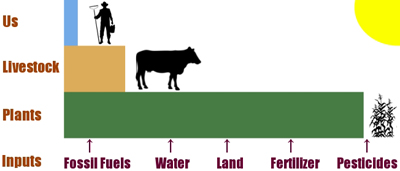
The PB & J Campaign's website is full of pro-plant propaganda illustrating just how much kinder to the environment a plant-based diet is than the resource-hogging, planet-polluting, livestock-based diet that most Americans eat. Their diagrams make the case for shortening our food chain, i.e. eliminating the middleman--or, rather, cow, pig, or chicken--and consuming plant foods directly:
2008-10-30-inputs1.jpg
In any pyramid, taking out a level lets you shrink the base. So, when you cut the livestock step out and eat plants directly, it takes a lot less of the plants to support you.
2008-10-30-inputs2.jpg
(Images courtesy of pbjcampaign.org)
The nut-lovers at The PB & J Campaign have crunched the numbers:
...the water it takes to produce the beef on one burger could produce peanuts for about 17 peanut butter and jelly sandwiches, and the land that it takes to produce that beef could produce peanuts for 19 PB&Js.
We've already had one pro-peanut president, and you know how that turned out. Jimmy Carter had that crazy fixation with energy independence, slapping solar panels on the White House roof and flaunting his woolly cardigan agenda.
In fact, the peanut has long been the preferred legume of liberals, going back to the mid-19th century when African American scientist George Washington Carver made it the foundation of his sustainable agriculture agenda for the South. Carver, a brilliant botanist, came up with something like a hundred different products made from peanuts, "including cosmetics, dyes, paints, plastics, gasoline, and nitroglycerin."
Another one of Carver's goals, according to Wikipedia, was to undermine "through the fame of his achievements and many talents, the widespread stereotype of the time that the black race was intellectually inferior to the white race."
So now, once again, a smart, ambitious black man is promoting peanuts. Is Obama part of a plant-based plot to conserve land and water and feed people more efficiently instead of pigging out on animal products at the expense of the entire universe? Has he secretly taken the PB & J pledge? When he talks about uniting red states and blue, is it some kind of coded reference to grape-jelly purple?
Look for the folks at Fox to get to the bottom of this--they may not know about eating low on the food chain, but they do know how to go low.
White Bean Alfredo Sauce
Pasta with marinara sauce is one meal that definitely qualifies as cheap and easy, but if you are looking to top your favorite pasta with a dairy-style sauce instead, you'll find that they're not as budget-friendly. Vegan cheeses and creams, like dairy versions, can be quite pricey, but the good news is that there's a cheap alternative—white beans.
 |
White beans can be beaten and blended into a creamy Alfredo-style pasta sauce in no time. The recipe requires only six ingredients, many of which you can find in just about any vegan kitchen.
The recipe below can be enjoyed tossed with your favorite pasta. You can also add veggies to make it a complete meal. Enjoy!
White Bean Alfredo Sauce
1/4 cup vegan margarine
2 cloves garlic, minced
2 cups cooked white beans, rinsed and drained
1 1/2 cups unsweetened soy milk
Salt and pepper, to taste
Parsley (optional)
•In a sauté pan over low heat, melt the margarine. Add the garlic and cook for 2 to 3 minutes.
•Transfer the margarine mixture to a blender or food processor, add the white beans and 1 cup of soy milk. Blend until completely smooth. If the sauce is too thick, add the remaining soy milk until you reach the desired consistency.
•Pour the sauce back into the pan over low heat, then season with salt and pepper to taste. Add fresh herbs, such as parsley, if desired. Cook until the sauce is warm.
Herbed Lemon Tofu

Herbed Lemon Tofuherbed_lemon_tofu.jpg
The tofu was baked in a combination of oil, herbs, and acidic goodness such as lemon juice and apple cider vinegar. During the baking process, I became worried that the tofu was burning, as I saw it browning and bubbling in the oven. I opened the oven door too many times to check on the dish, which added an extra 10 minutes to the cooking time. Later, I realized that the "almost burning" part is necessary to achieve a chewy texture for the tofu. So, my tip for making this recipe work? Just leave the oven light off and the door closed.
Enjoy!
Herbed Lemon Tofu
1 lb. extra-firm tofu
2 Tbsp. lemon juice
1/2 Tbsp. apple cider vinegar
2 Tbsp. soy sauce
2 Tbsp. olive oil
2 tsp. chopped thyme
Pepper, to taste
•Preheat the oven to 475°F.
•Wrap the block of tofu in paper towels and press for 10 minutes by adding weight on top. Remove the paper towels and cut the tofu into 1/2-inch-thick pieces.
•Combine the remaining ingredients in a small bowl.
•Add the tofu to a casserole or baking dish in a single layer, then cover with the liquid mixture, turning once to coat.
•Bake the tofu for 30 to 40 minutes, or until browned, and turn once halfway through baking.
Chinese Vegetable and Hoisin Stir-Fry

Prep Time: 10 minutes
Cook Time: 15 minutes
Ingredients:
- 3 tbsp hoisin sauce
- 1 tbsp sesame oil+ 2 tbsp
- 2 tbsp soy sauce + 2 tbsp
- 1 tbsp rice vinegar
- 2 tbsp sugar or liquid sweetener
- 3/4 cup vegetable broth
- 2 cloves garlic, minced
- 1 tsp fresh ginger, minced
- 1 tbsp corn starch
- approx. 1 cup seitan, chopped into 1 inch pieces
- 3-4 green onions, chopped
- 1 red or yellow bell pepper
- approx 2 cups broccoli, chopped
Preparation:
In a large wok or skillet, stir-fry seitan in 2 tbsp sesame oil and 2 tbsp soy sauce until lightly browned, about 3 minutes. Ad

d onions, pepper and broccoli and stir-fry another 2-3 minutes.
Add sauce mixture to the stir-fry and combine well, allowing to cook another 2-3 minutes, until broccoli is done cooking.
The Low-Carbon Diet
By Mike Tidwell/Photography by Catherine Ledner
Full disclosure: I love to eat meat. I was born in Memphis, the barbecue capital of the Milky Way Galaxy. I worship slow-cooked, hickory-smoked pig meat served on a bun with extra sauce and coleslaw spooned on top.
My carnivore’s lust goes beyond the DNA level. It’s in my soul. Even the cruelty of factory farming doesn’t temper my desire, I’ll admit. Like most Americans, I can somehow keep at bay all thoughts of what happened to the meat prior to the plate.
So why in the world am I a dedicated vegetarian? Why is meat, including sumptuous pork, a complete stranger to my fork at home and away? The answer is simple: I have an 11-year-old son whose future—like yours and mine—is rapidly unraveling due to global warming. And what we put on our plates can directly accelerate or decelerate the heating trend.
That giant chunk of an Antarctic ice sheet, the one that disintegrated in a matter of hours, the one the size of seven Manhattans—did you hear about it? It shattered barely a year ago “like a hammer on glass,” scientists say, and is now melting away in the Southern Ocean. This is just a preview, of course, of the sort of ecological collapse coming everywhere on earth, experts say, unless we hit the brakes soon on climate change. If the entire West Antarctic ice sheet melts, for example, global sea-level rise could reach 20 feet.
Since the twin phenomena of Hurricane Katrina and Hurricane Gore, most Americans have a basic literacy on the issue of climate change. It’s getting worse, we know, and greenhouse gases—emitted when we burn fossil fuels—are driving it. Less accepted, it seems, is the role food—specifically our consumption of meat—is playing in this matter. The typical American diet now weighs in at more than 3,700 calories per day, reports the U.N. Food and Agriculture Organization, and is dominated by meat and animal products. As a result, what we put in our mouths now ranks up there with our driving habits and our use of coal-fired electricity in terms of how it affects climate change.
Simply put, raising beef, pigs, sheep, chicken, and eggs is very, very energy intensive. More than half of all the grains grown in America actually go to feed animals, not people, says the World Resources Institute. That means a huge fraction of the petroleum-based herbicides, pesticides, and fertilizers applied to grains, plus staggering percentages of all agricultural land and water use, are put in the service of livestock. Stop eating animals and you use dramatically less fossil fuels, as much as 250 gallons less oil per year for vegans, says Cornell University’s David Pimentel, and 160 gallons less for egg-and-cheese-eating vegetarians.
But fossil fuel combustion is just part of the climate–diet equation. Ruminants—cows and sheep—generate a powerful greenhouse gas through their normal digestive processes (think burping and emissions at the other end). What comes out is methane (23 times more powerful at trapping heat than CO2) and nitrous oxide (296 times more powerful).
Indeed, accounting for all factors, livestock production worldwide is responsible for a whopping 18 percent of the world’s total greenhouse gases, reports the U.N. Food and Agriculture Organization. That’s more than the emissions of all the world’s cars, buses, planes, and trains combined.
So why do we so rarely talk about meat consumption when discussing global warming in America? Compact fluorescent bulbs? Biking to work? Buying wind power? We hear it nonstop. But even the super-liberal, Prius-driving, Green Party activist in America typically eats chicken wings and morning bacon like everyone else. While the climate impacts of meat consumption might be new to many people, the knowledge of meat’s general ecological harm is not at all novel. So what gives?
Roughly three percent of all Americans are vegetarians, according to the Vegetarian Resource Group, a nonprofit that educates people on the benefits of a meat-free diet. Part of the reason, I know, is the unfortunate belief that vegetarianism is a really tough lifestyle change, much harder than simply changing bulbs or buying a better car. But as a meat lover at heart, I’ve been a vegetarian (no fish, minimal eggs and cheese) for seven years, and trust me: It’s easy, satisfying, and of course super healthy. With the advent of savory tofu, faux meats, and the explosion of local farmers’ markets, a life without meat is many times easier today than when Ovid and Thoreau and Gandhi and Einstein did it. True, many meat substitutes are made from soybeans, a monocrop with its own environmental issues. But most soy production today is actually devoted to livestock feed. Only 1 percent of U.S. soybeans become tofu, for example.
One day I get carryout veggie Pad Thai. The next I cook stir-fried veggies at home with soy-based sausage patties so good they fool even the most discriminating meat connoisseurs. Bottom line: Of the most difficult things I’ve ever done in my life, vegetarianism doesn’t even make the chart.
Some folks, I realize, have a deep-down, gut-level (so to speak) reaction to vegetarianism as “unnatural.” We humans have canine teeth, after all. We evolved to include meat in our diets. To abandon such food is to break thousands of years of tradition and, in some cases, ritual behavior bordering on the sacred.
All true. But we also evolved as people who defecated indiscriminately in the woods and who didn’t brush our teeth. Somehow we’ve moved to a higher level on those counts. Now, with potentially catastrophic climate change hovering around the corner and with our briskets and London broil helping to drive the process, it’s time to evolve some more.
A compromise in recent years, of course, has been the idea of animals raised locally and organically. Becoming a “locavore” who eats regional fruits and vegetables in season as much as possible makes abundant sense, of course. And animals from your area can lower the environmental impacts of your diet in many ways while simultaneously saving cherished local farmland and progressive farm families.
But with global warming, here’s the inconvenient truth about meat and dairy products: If you eat them, regardless of their origin and how they were produced, you significantly contribute to climate change. Period. If your beef is from New Zealand or your own backyard, if your lamb is organic free-range or factory farmed, it still has a negative impact on global warming.
This is true for several reasons. Again, the biological reality of ruminant digestion is that methane is released. The feed can be local and organic, but the methane is the same, escaping into the atmosphere and trapping heat with impressive efficiency. Second, no matter the farming method, livestock makes manure that produces nitrous oxide, an even more awesomely impressive heat trapper. Livestock in the United States generates a billion tons of manure per year, accounting for 65 percent of the planet’s anthropogenic nitrous oxide emissions.
Even poultry, while less harmful, also contributes. Ironically, data released in 2007 by Adrian Williams of Cranfield University in England show that when all factors are considered, organic, free-range chickens have a 20 percent greater impact on global warming than conventionally raised broiler birds. That’s because “sustainable” chickens take longer to raise, and eat more feed. Worse, organic eggs have a 14 percent higher impact on the climate than eggs from caged chickens, according to Williams.
“If we want to fight global warming through the food we buy, then one thing’s clear: We have to drastically reduce the meat we consume,” says Tara Garnett of London’s Food Climate Research Network.
So while some of us Americans fashionably fret over our food’s travel budget and organic content, Garnett says the real question is, “Did it come from an animal or did it not come from an animal?”
Which brings us back to vegetarianism and why I live a meat-free life. The facts speak for themselves. If we really want to fight climate change, we should change our lightbulbs and purchase hybrid cars and, above all, vote for politicians committed to a clean energy future. But we should also eat less meat, a lot less, or none at all.
I believe consumer habits are starting to change similarly to the way they’ve shifted with compact fluorescent bulbs. Ten years ago people complained about the harsh quality of light from fluorescents and the hassle of switching them out. But the bulbs are now made to produce a much warmer quality of light and the price has come down. What’s more, in seven years of using only CFLs at my home, I’ve never had a guest make a single comment.
In the near future, as we increasingly discuss the climate “facts” of meat consumption, and as veggie cuisine gets still easier at home and at restaurants, we’ll see more and more people changing their diets in the same way they’re switching to CFLs in droves now. Of this I’m sure.
But when it comes to food, the facts are not enough for many people. Of this I’m also sure. A holistic nutritionist in my neighborhood says one’s ideas about food reside in the same part of the brain that houses our ideas and beliefs about religion. It’s not all rational, in other words. Facts abound about the harm of fatty, sugary foods, yet the obesity epidemic grows. And I can’t count the number of environmental conferences I’ve attended where meat was served in abundance. Even Michael Pollan’s 2006 bestseller The Omnivore’s Dilemma, wherein he dissects with encyclopedic thoroughness the eco-hazards and animal cruelty issues surrounding meat and egg production—even this book astonishingly mentions the words global warming only two times and climate change not at all. In 464 pages. That’s highly unreasonable, in my view.
All of which is to say that for people to care, the climate–food discussion must be about more than just facts, more than pounds of greenhouse gases per units of food. It’s got to be about morality, about right versus wrong. And I don’t mean the usual morality of environmental “stewardship.” Or even the issue of cruelty to farm animals. I’m talking here about cruelty to people, about the explicit harm to humans that results from meat consumption and its role as a driving force in climate change. Knowingly eating food that makes you fat or harms your local fish and birds is one thing. Knowingly eating food that makes children across much of the world hungry is another.
I served as a Peace Corps volunteer in the Democratic Republic of the Congo in the mid-1980s, living in a tiny rural village where the staple crop was hand-tilled corn. It was harvested twice a year, in May and December. This meant the two annual “rainy seasons” had to begin right on time, in January and September, and continue for several months afterward. Any deviation from this rainfall pattern virtually guaranteed a lower corn harvest. And given the total absence of grocery stores, community granaries, or the money to buy extra food even if it existed, this meant hunger.
A signature impact of global warming, of course, is a dramatic shift in precipitation patterns worldwide, including longer and more severe droughts as well as extreme rainstorms and flooding in non-drought areas. Many scientists believe these impacts are already being felt by farmers worldwide and could spell future disaster, especially for subsistence farmers like those I lived with in Africa. Global wheat prices have jumped about 100 percent in the past year in part because a record drought in Australia—made worse by global warming—has devastated farmers across the continent. Food production in China alone could drop 10 percent as early as 2030, United Nations scientists warn.
The people I lived with in Africa contribute almost nothing to the problem of global warming, through their diet or otherwise. Coal-fired electricity versus wind power? They don’t have electricity. SUVs versus hybrid cars? They don’t have cars—none at all, or roads for that matter. And meat consumption? Tiny, tiny portions maybe twice a week.
If we in the West don’t alter course in the coming years, if we allow extreme global warming to become reality, an impact on the U.S. diet could very well be a great reduction in the amount of meat on our tables—a reduction imposed on us by nature instead of achieved by us through enlightened lifestyle changes. The wide and guaranteed availability of agriculturally productive land may simply cease. The crop yields we see now could shrink significantly, thanks to everything from weird weather to pest invasions. But it’s a safe guess to say we’ll have space for a national diet of plant-based foods (some crops are expected to benefit from global warming), just not the option of consuming all those animals.
But in the Congo and other poor countries, in places like Bangladesh and Peru and Vietnam, where meat consumption is already low, severe climate change means food off the table. It means hungry children. It means the rains don’t come on time or at all in tiny villages like the one I lived in. It means, in the end, cruelty to people.
Are we clear now on the raw facts and urgent morality of our present meat consumption in America?
We need much more than just a few magazine readers to voluntarily stop eating meat, of course. It’s a good start, but what we really need are national policies that encourage lower meat consumption by everyone. This could be achieved using fees or other market mechanisms that properly price greenhouse-gas emissions according to the harm they cause. The bad news, I suppose, is that the cost of meat could rise. The good news is we would finally have a fair and honest way to judge its danger, and thus more incentives to do the right thing, more incentives to switch to a healthy and convenient vegetarian diet of the sort I’ve joyfully embraced for years, despite my great appreciation for the taste of meat.
We could also, as a nation, just eat a lot less meat as an alternative to full vegetarianism. Anthony McMichael, a leading Australia-based expert on climate change and health issues, has crunched the numbers. He estimates that per capita daily meat consumption would need to drop from about 12 ounces per day in America to 3.1 ounces (with less than half of it red meat) in order to protect the climate.
I suppose I could measure out 3.1 ounces of meat per day, cook it, eat it, and still feel morally okay. But frankly I’d rather just go without. I’d rather be a vegetarian. It’s easier to explain. It’s easier to defend. And I just plain like it.
Mike Tidwell, director of the Chesapeake Climate Action Network, is the author of The Ravaging Tide: Strange Weather, Future Katrinas, and the Coming Death of America's Coastal Cities (Free Press).
Vegetarian Chinese Hot and Sour Soup

See also: More vegetarian soup recipes
Ingredients:
- 6 cups vegetable broth
- 2 cups mushrooms, sliced (Chinese wood ear mushrooms or shiitake are best)
- 1 small can bamboo shoots
- 1 small can water chestnuts
- 2 tbsp soy sauce
- 1/2 tsp pepper
- 1 tsp hot sauce
- 2 tbsp vinegar
- 3 cloves garlic, minced
- 1/2 cup scallions (green onions), sliced
- 2 tbsp chili oil
Preparation:
Allow to simmer for at least 20 minutes.
Add the scallions and  simmer for about 5 more minutes. Stir in the chili oil.
Add additional soy sauce, hot sauce or vinegar to taste.
Enjoy your vegetarian Chinese hot and sour soup!
Vegetarian Potstickers with Mushroom and Tofu Recipe

I made these vegetarian potstickers with mushrooms and tofu for a vegan potluck a while ago, and they were completely gone about 2 minutes after they hit the table! These vegetarian potstickers are little steamed dumplings similar to Japanese gyoza. Unlike traditional Chinese potstickers, I like to steam these rather than pan-fry them, to make them lower in fat. Whether you call them steamed dumplings, Chinese potstickers or Japanese gyoza, you may want to make a double batch, as your guests will call them "yummy!".
Ingredients:
- 2 tbsp olive oil
- 1 block tofu, well pressed, and crumbled
- 1/2 cup shiitake mushrooms, diced small
- 1/2 cup Napa cabbage, diced small
- 1/2 tsp minced fresh ginger
- 2 cloves garlic, minced
- 3 scallions, diced
- 2 tbsp soy sauce
- 1 tsp sesame oil
- dash red pepper flakes (optional)
- 2 tbsp chopped fresh cilantro (optional)
- wonton or gyoza wrappers
Preparation:
Sautee the crumbled tofu, mushrooms and cabbage in olive oil along with ginger and garlic for a few minutes. When the tofu and mushrooms are almost done cooking, add the scallions, soy sauce, sesame oil and red pepper flakes, stirring well to combine.Allow to cook for one or two more minutes, then remove from heat and allow to cool slightly. Stir in the fresh cilantro.
Place about 1 tablespoon of the tofu and mushroom mixture into each wonton wrapper or gyoza wrapper. Moisten the edges of the wrapper with a bit of water, then fold in half and press to seal. Make a couple of pinches or folds to create a fan-like shape. This will help to seal the filling inside the dumpling. It may take a couple of tries to get the technique just right, but once you do, it's really quite easy!
Heat a couple of inches of water in a large pan, and place a vegetable steamer inside. Place the potstickers, a few at a time, on the steamer, cover, and steam your vegetarian potstickers for 2 - 3 minutes on each side. Potstickers are done steaming when they are soft and pliable.
If you prefer, you can also pan-fry these little dumplings, like traditional Chinese potstickers or Japanese gyoza. Click here to see how.
Vitamin 12
Introduction
Vitamin B
 12 is a member of the vitamin B complex. It contains cobalt, and so is also known as cobalamin. It is exclusively synthesised by bacteria and is found primarily in meat, eggs and dairy products. There has been considerable research into proposed plant sources of vitamin B12. Fermented soya products, seaweeds, and algae such as spirulina have all been suggested as containing significant B12. However, the present consensus is that any B12 present in plant foods is likely to be unavailable to humans and so these foods should not be relied upon as safe sources. Many vegan foods are supplemented with B12. Vitamin B12 is necessary for the synthesis of red blood cells, the maintenance of the nervous system, and growth and development in children. Deficiency can cause anaemia. Vitamin B12 neuropathy, involving the degeneration of nerve fibres and irreversible neurological damage, can also occur.
 Functions
B12 is also important in maintaining the nervous system. Nerves are surrounded by an insulating fatty sheath comprised of a complex protein called myelin. B12 plays a vital role in the metabolism of fatty acids essential for the maintainence of myelin. Prolonged B12 deficiency can lead to nerve degeneration and irreversible neurological damage.
When deficiency occurs, it is more commonly linked to a failure to effectively absorb B12 from the intestine rather than a dietary deficiency. Absorption of B12 requires the secretion from the cells lining the stomach of a glycoprotein, known as intrinsic factor. The B12-intrinsic factor complex is then absorbed in the ileum (part of the small intestine) in the presence of calcium. Certain people are unable to produce intrinsic factor and the subsequent pernicious anaemia is treated with injections of B12.
Vitamin B12 can be stored in small amounts by the body. Total body store is 2-5mg in adults. Around 80% of this is stored in the liver.
Vitamin B12 is excreted in the bile and is effectively reabsorbed. This is known as enterohepatic circulation. The amount of B12 excreted in the bile can vary from 1 to 10ug (micrograms) a day. People on diets low in B12, including vegans and some vegetarians, may be obtaining more B12 from reabsorption than from dietary sources. Reabsorption is the reason it can take over 20 years for deficiency disease to develop in people changing to diets absent in B12. In comparison, if B12 deficiency is due to a failure in absorption it can take only 3 years for deficiency disease to occur.
Dietary Sources
Spirulina, an algae available as a dietary supplement in tablet form, and nori, a seaweed, have both appeared to contain significant amounts of B12 after analysis. However, it is thought that this is due to the presence of compounds structurally similar to B12, known as B12 analogues. These cannot be utilised to satisfy dietary needs. Assay methods used to detect B12 are unable to differentiate between B12 and it's analogues, Analysis of possible B12 sources may give false positive results due to the presence of these analogues.
Researchers have suggested that supposed B12 supplements such as spirulina may in fact increase the risk of B12 deficiency disease, as the B12 analogues can compete with B12 and inhibit metabolism.
The current nutritional consensus is that no plant foods can be relied on as a safe source of vitamin B12.
Bacteria present in the large intestine are able to synthesise B12. In the past, it has been thought that the B12 produced by these colonic bacteria could be absorbed and utilised by humans. However, the bacteria produce B12 too far down the intestine for absorption to occur, B12 not being absorbed through the colon lining.
Human faeces can contain significant B12. A study has shown that a group of Iranian vegans obtained adequate B12 from unwashed vegetables which had been fertilised with human manure. Faecal contamination of vegetables and other plant foods can make a significant contribution to dietary needs, particularly in areas where hygiene standards may be low. This may be responsible for the lack of aneamia due to B12 deficiency in vegan communities in developing countries.
Good sources of vitamin B12 for vegetarians are dairy products or free-range eggs. ½ pint of milk (full fat or semi skimmed) contains 1.2 µg. A slice of vegetarian cheddar cheese (40g) contains 0.5 µg. A boiled egg contains 0.7 µg. Fermentation in the manufacture of yoghurt destroys much of the B12 present. Boiling milk can also destroy much of the B12.
Vegans are recommended to ensure their diet includes foods fortified with vitamin B12. A range of B12 fortified foods are available. These include yeast extracts, Vecon vegetable stock, veggieburger mixes, textured vegetable protein, soya milks, vegetable and sunflower margarines, and breakfast cereals.
Required Intakes
| Age | RNI |
| 0 to 6 months | 0.3 µg |
| 7 to 12 months | 0.4 µg |
| 1 to 3 yrs | 0.5 µg |
| 4 to 6 yrs | 0.8 µg |
| 7 to 10 yrs | 1.0 µg |
| 11 to 14 yrs | 1.2 µg |
| 15 + yrs | 1.5 µg |
| Breast feeding women | 2.0 µg |
Pregnant women are not thought to require any extra B12, though little is known about this. Lactating women need extra B12 to ensure an adequate supply in breast milk.
B12 has very low toxicity and high intakes are not thought to be dangerous.
Vegetarian Advice: Milk, Beef, Omega 3's
Question: Vegetarian research, can't find answers about milk, animal cruelty, beef products and Omega 3's
I have been researching vegetarianism, and had questions about milk, animal cruelty, beef products and Omega 3's, that I can't seem to find the answer to - J.R.
1) I keep reading things about soy milk and other milk alternatives. It was my understanding that not drinking milk would fall under Veganism. Is there something in the process of getting milk that hurts/kills a cow (animal cruelty)?
2) Growing up, I had a friend who was vegetarian, and once I offered her some sort of mass produced baked good product (think Hostess). She looked at the wrapper and said that she couldn't eat it because there was a beef product in it. When I looked at the wrapper I did not see it anywhere and she mentioned that it was called something else - a name I can't remember. Are there things like that nowadays (this was about 8 years ago) that I should be checking for on labels, or do companies spell things out better?
3) When I mention going vegetarian to others, I am warned continuously about getting enough Omega-3 for my brain and that this is strictly in fish oil. Is there another source for this?
Savvy Vegetarian Advice
Dear J.R.,
Milk Production and Animal Cruelty: In conventional dairies, and even in some organic dairies, cows lead short, unhealthy, and stressful lives (3 - 4 years, instead of their normal life span of 20 years - a few years longer in organic dairies), and end up in the slaughter house. In conventional dairies, they don't have access to pasture. They are milked at least three times a day. They live in small stalls, with constant lights and noise (the milking machines are extremely loud). The cows are pumped full of drugs to boost milk production - they are considered milk producing machines. Their calves usually become veal, unless they're female. The normal cow life cycles are completely disregarded.
Organic dairies usually treat the cows more humanely, but they're still considered production units, not family pets (with some exceptions). If you want to drink milk, buy organic, reduce your consumption, and remember, drinking a bit of cows milk is an improvement over eating the cow, so don't feel you have to evolve to full fledged vegan overnight.
Beef Products in Packaged Food: It could have been gelatin, stearic acid, or glycerin. All are used as binders, and have various trade names. It could have been lard, or margarine. Beef by products are found in many consumer products - here's a list. It's always a good idea to read labels - ingredients like that are usually listed. But labelling requirements are getting looser, not stricter. It's safe to assume that there could be nasties in processed foods that aren't mentioned on the labels.
Vegetarian Sources of Omega 3's: Yes, there are vegetarian sources of Omega 3's! It's just another anti-vegetarian myth, that there aren't. Flax oil and ground flax seeds are a good source of Omega 3's, as well as walnuts, hemp seeds, soybeans, and pumpkin seeds. There is a small amount of Omega 3's in avocados, olive oil, and whole grains. It's important to have some of those foods everyday - most people, including non-vegetarians, don't get nearly enough Omega 3's in their diets, even though you don't need much.
It's easy to incorporate flax oil in salad dressings, mix it with steamed veggies or cereal - it shouldn't be cooked. Ground flax seeds can be used in cooked cereals, or in baked goods (it's also an egg replacer). Flax oil is highly volatile, and goes rancid quickly. Keep it in the fridge, and used it up quickly. If you can, it's best to grind your flax seeds fresh, in a coffee grinder (not used for coffee beans). Ground flax seeds will keep in the fridge for a few days in a sealed container. Walnuts are good in salads, or as a snack (nice with raisins and sunflower seeds, or in baked goods or cereal. Make sure they're fresh, not rancid. Hemp seed milk is a balanced source of Omega 3 and Omega 6. Keep all shelled nuts and oils in the fridge.
Going Vegetarian
| Going vegetarian | |
Why Become Vegetarian? There are as many reasons for becoming vegetarian as there are vegetarians; it's a highly personal and individual decision to make. But in a survey conducted on behalf of The Vegetarian Society the majority of people said that they gave up meat and fish because they did not morally approve of killing animals, or because they objected to the ways in which animals are kept, treated and killed for food. With the growing awareness of the importance of healthy food, many people are also becoming vegetarian because it matches the kind of low fat, high fibre diet recommended by dieticians and doctors. Concern about the environment is another factor as people become more aware of the effect raising animals for their meat is having on the environment. Or you may be concerned about wasting world food resources by using land to raise animals for meat instead of growing crops that can feed more people directly. See the Information Sheet on Statistics for further details of surveys. Common Questions about Vegetarianism Use these answers to some of the most common questions asked about vegetarianism to put at rest your own mind, or to respond to any queries from meat-eating friends. What is a Vegetarian?A vegetarian is someone who does not eat meat, fish, poultry or any slaughterhouse by-product such as gelatine. Vegetarians live on a diet of grains, pulses, nuts, seeds, vegetables and fruit, with or without free-range eggs, milk and milk products. Vegetarians not eating anything containing dairy products or eggs are called vegans. See the Information Sheet on Definitions for further details. Isn't it hard being a vegetarian?Not at all. Vegetarian food is widely available in shops and restaurants, it's easy to cook and you're probably already eating many vegetarian meals such as beans on toast or jacket potato and cheese without even putting your mind to it. It's no sacrifice to give up meat when there are so many delicious recipes and so many tasty foods to experiment with. Plus you'll have the satisfaction of knowing that you're eating a healthy diet that doesn't involve the killing of animals or the abuse of the world's resources.Where will I buy all this new food for my vegetarian diet?Exactly the same place you used to buy food - in markets, supermarkets, corner shops. Vegetarian food, both in its 'raw state' as grains, pulses and vegetables, and as pre-cooked meals, is widely available nowadays.What do I say to my family/friends?Don't get caught up in arguments, just gather all the information about vegetarianism so you can calmly explain your decision. Then try introducing them to some of the delicious meat-free meals you're enjoying and see if you can win them over by setting a good example.Aren't vegetarians being hypocritical because they still wear leather or exploit cows for their milk?There is a very valid argument for becoming vegan - for giving up all dairy products, eggs and any other animal by-products. But realistically speaking, few people can go from being a meat eater to a vegan overnight. Vegetarianism is a very important halfway house. And even if you never go on to being vegan, you've already made an impact and saved the lives of many animals simply by giving up meat. Far from being hypocritical, you're making an effort to change the way you live for the better. How far you go with vegetarianism is up to you, but however small the step you take, it's not wasted. And don't feel that you have to become a perfect vegetarian overnight. If you forget to check the ingredients list and realise that you've just eaten something containing gelatine, don't feel that you've failed. Take it one step at a time and enjoy learning more about the vegetarian lifestyle. The important thing is that you're doing something!See also the Information Sheet on Clothing Aren't all vegetarians pale and unhealthy?This old stereotype has taken a long time to die out. In fact, people who follow a varied, well-balanced vegetarian diet are in line with the current nutritional recommendations for a low fat, high fibre diet. That's why medical studies are proving that vegetarians are less likely to suffer from such illnesses as heart disease, cancer, diet-related diabetes, obesity and high blood pressure. So, if for no other reason, go vegetarian as a favour to your body!See also the Health and Nutrition Index. What happens if I have to try to get a vegetarian meal in a restaurant?There are very few restaurants now that don't offer at least one vegetarian option. Vegetarianism is such a growing movement, restaurateurs can't afford to ignore it. In the unlikely event that a restaurant doesn't have anything for you, don't be put fobbed off, especially with the offer of a fish or chicken dish which are 'practically vegetarian' - they're not!! Simply ask politely if they can make something specially for you. if they can't be bothered, why give them the benefit of your custom when there are plenty of other places all too willing to help.See Eating Out Index for restaurants in your area. Isn't vegetarian food boring?Vegetarians don't eke out a miserable existence on a few limp lettuce leaves and some boiled rice. And a proper vegetarian meal doesn't mean taking the meat away and leaving the side vegetables. With the hundreds of different vegetables, grains, fruit, pulses and nuts and seeds that exist, you could live to be 100 without exhausting all the possibilities for imaginative, nutritious meals! And as vegetarian food tends to be cheaper than a meat-based diet, you can afford to treat yourself to more expensive delicacies such as asparagus.See the Recipes Index for ideas. Won't it take a long time to prepare the food?Just because there are so many wonderful vegetarian dishes to try, doesn't mean you have to become an expert cook and spend hours in the kitchen. You can easily cook good, wholesome vegetarian meals in under half an hour, and don't forget that most manufacturers now also offer a wide range of ready-made vegetarian dishes.See Books and for some quick and easy recipes - Meat-free made easy But how will I get enough of the vital nutrients such as iron and protein?A well-balanced vegetarian diet provides all the nutrients you need for good health. In the case of protein, it's not only found in meat. It's also present in adequate quantities in dairy products, eggs and nuts, as well as in combinations of foods such as pulses and grains. In fact it would be very difficult to design a vegetarian diet that doesn't include enough protein.See also the Health and Nutrition Index for further details. Useful Tips on Going and Staying Vegetarian
|


