Featurettes Soul Food Nation

Bring on the braised greens! Soul food—healthy, sustainable, soul food—has arrived, thanks to chef and cookbook author Bryant Terry.
By Elizabeth Castoria
If the first thing that comes to mind when you hear the phrase “soul food” isn’t sustainable agriculture with a side of social justice, you clearly haven’t met Bryant Terry. The 35-year-old activist (and Aquarius, as he quickly points out) is on the brink of making soul food synonymous with healthy living and stable, fair food systems. Though Terry says the food-justice movement has come a long way, there’s still a long way to go for those who want to see a healthy, nourished nation with equal access to fresh produce. In working toward that goal, Terry’s been featured on the Sundance Channel’s “Big Id
VegNews: Are you a vegetarian?
Bryant Terry: I became a vegetarian in high school. Then a vegan. Then a fruitarian for a summer in college. Then a breathatarian for a day. Then a pescetarian in graduate school. Then back to being a vegan ... As one can tell, my relationship with food has been fluid, shifting as I have changed. So I choose not to label my diet at all, nowadays. But if I were to characterize it, I would say that I have a plant-centered diet devoid of meat.
VN: How has food justice changed since you first became involved?
BT: It has moved from the margin closer to the center.
VN: What’s been your proudest moment as an activist?
BT: When I stopped being dogmatic, self-righteous, and judgmental.
VN: Have you been able to convince your family members—who you’ve said inspired you to focus your work in the South—to eat more healthfully?
BT: I have convinced many of my family members in the South to eat more of the fresh, seasonal, and sustainable foods that they grew up eating. It’s about helping them remember, not teaching them anything new.
VN: What’s your favorite meal?
BT: Vegetable pho (Vietnamese rice-noodle soup).
VN: Why use “vegan” in the title of your book and make all the recipes vegan if you don’t identify yourself as a vegan?
BT: Vegan Soul Kitchen provides a much-needed intervention in a genre oversaturated with books that include animal products. And this book is for everyone to enjoy no matter what her or his habitual eating habits might be.
VN: What upcoming project are you most excited about and why?
BT: Starting a family. It’s the most important thing to me.
Top 10 Veg Pick-up Lines

Need a little extra help to secure that sought-after date? Let the, er, experts at VegNews show you how it's done.
1. If I said you had the body of an all-natural, organic-living, animal-loving, environment-nurturing, whale-saving sex machine, would you hold it against me? Please?
2. May I take your picture? It’s for the World’s Sexiest Vegetarian competition.
3. Could you help me out? I’m trying to decide if I want to keep these new hemp sheets, but I need a second opinion.
4. Your organic cotton t-shirt looks really soft. Can I feel it?
5. Wanna come up and see my Vitamix?
6. What’s your favorite thing to do with agave nectar?
7. Do you like my new skirt? I love pleather but it makes me all hot and sweaty.
8. Mmmmm. I could really go for a hot veggie dog right about now.
9. I’ll eat Hip Whip on anything.
10. How do you get your protein?
Obama a Vegan Socialist???The nutty Conspiracy

Oh, sure, it sounds innocent enough. That's because you haven't heard about a shadowy group of subversive sandwich shillers called The PB & J Campaign. No, they're not a bunch of bread boosters, or a front for the peanut lobby, or the jelly industry. The PB & J Campaign is a nutty group of "private citizens concerned about the environment" on a feel-gooey mission to convince Americans to "fight global warming by having a PB&J for lunch."
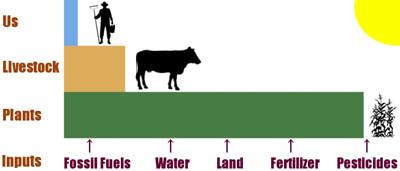
The PB & J Campaign's website is full of pro-plant propaganda illustrating just how much kinder to the environment a plant-based diet is than the resource-hogging, planet-polluting, livestock-based diet that most Americans eat. Their diagrams make the case for shortening our food chain, i.e. eliminating the middleman--or, rather, cow, pig, or chicken--and consuming plant foods directly:
2008-10-30-inputs1.jpg
In any pyramid, taking out a level lets you shrink the base. So, when you cut the livestock step out and eat plants directly, it takes a lot less of the plants to support you.
2008-10-30-inputs2.jpg
(Images courtesy of pbjcampaign.org)
The nut-lovers at The PB & J Campaign have crunched the numbers:
...the water it takes to produce the beef on one burger could produce peanuts for about 17 peanut butter and jelly sandwiches, and the land that it takes to produce that beef could produce peanuts for 19 PB&Js.
We've already had one pro-peanut president, and you know how that turned out. Jimmy Carter had that crazy fixation with energy independence, slapping solar panels on the White House roof and flaunting his woolly cardigan agenda.
In fact, the peanut has long been the preferred legume of liberals, going back to the mid-19th century when African American scientist George Washington Carver made it the foundation of his sustainable agriculture agenda for the South. Carver, a brilliant botanist, came up with something like a hundred different products made from peanuts, "including cosmetics, dyes, paints, plastics, gasoline, and nitroglycerin."
Another one of Carver's goals, according to Wikipedia, was to undermine "through the fame of his achievements and many talents, the widespread stereotype of the time that the black race was intellectually inferior to the white race."
So now, once again, a smart, ambitious black man is promoting peanuts. Is Obama part of a plant-based plot to conserve land and water and feed people more efficiently instead of pigging out on animal products at the expense of the entire universe? Has he secretly taken the PB & J pledge? When he talks about uniting red states and blue, is it some kind of coded reference to grape-jelly purple?
Look for the folks at Fox to get to the bottom of this--they may not know about eating low on the food chain, but they do know how to go low.
White Bean Alfredo Sauce
Pasta with marinara sauce is one meal that definitely qualifies as cheap and easy, but if you are looking to top your favorite pasta with a dairy-style sauce instead, you'll find that they're not as budget-friendly. Vegan cheeses and creams, like dairy versions, can be quite pricey, but the good news is that there's a cheap alternative—white beans.
 |
White beans can be beaten and blended into a creamy Alfredo-style pasta sauce in no time. The recipe requires only six ingredients, many of which you can find in just about any vegan kitchen.
The recipe below can be enjoyed tossed with your favorite pasta. You can also add veggies to make it a complete meal. Enjoy!
White Bean Alfredo Sauce
1/4 cup vegan margarine
2 cloves garlic, minced
2 cups cooked white beans, rinsed and drained
1 1/2 cups unsweetened soy milk
Salt and pepper, to taste
Parsley (optional)
•In a sauté pan over low heat, melt the margarine. Add the garlic and cook for 2 to 3 minutes.
•Transfer the margarine mixture to a blender or food processor, add the white beans and 1 cup of soy milk. Blend until completely smooth. If the sauce is too thick, add the remaining soy milk until you reach the desired consistency.
•Pour the sauce back into the pan over low heat, then season with salt and pepper to taste. Add fresh herbs, such as parsley, if desired. Cook until the sauce is warm.
Herbed Lemon Tofu

Herbed Lemon Tofuherbed_lemon_tofu.jpg
The tofu was baked in a combination of oil, herbs, and acidic goodness such as lemon juice and apple cider vinegar. During the baking process, I became worried that the tofu was burning, as I saw it browning and bubbling in the oven. I opened the oven door too many times to check on the dish, which added an extra 10 minutes to the cooking time. Later, I realized that the "almost burning" part is necessary to achieve a chewy texture for the tofu. So, my tip for making this recipe work? Just leave the oven light off and the door closed.
Enjoy!
Herbed Lemon Tofu
1 lb. extra-firm tofu
2 Tbsp. lemon juice
1/2 Tbsp. apple cider vinegar
2 Tbsp. soy sauce
2 Tbsp. olive oil
2 tsp. chopped thyme
Pepper, to taste
•Preheat the oven to 475°F.
•Wrap the block of tofu in paper towels and press for 10 minutes by adding weight on top. Remove the paper towels and cut the tofu into 1/2-inch-thick pieces.
•Combine the remaining ingredients in a small bowl.
•Add the tofu to a casserole or baking dish in a single layer, then cover with the liquid mixture, turning once to coat.
•Bake the tofu for 30 to 40 minutes, or until browned, and turn once halfway through baking.
The Low-Carbon Diet
By Mike Tidwell/Photography by Catherine Ledner
Full disclosure: I love to eat meat. I was born in Memphis, the barbecue capital of the Milky Way Galaxy. I worship slow-cooked, hickory-smoked pig meat served on a bun with extra sauce and coleslaw spooned on top.
My carnivore’s lust goes beyond the DNA level. It’s in my soul. Even the cruelty of factory farming doesn’t temper my desire, I’ll admit. Like most Americans, I can somehow keep at bay all thoughts of what happened to the meat prior to the plate.
So why in the world am I a dedicated vegetarian? Why is meat, including sumptuous pork, a complete stranger to my fork at home and away? The answer is simple: I have an 11-year-old son whose future—like yours and mine—is rapidly unraveling due to global warming. And what we put on our plates can directly accelerate or decelerate the heating trend.
That giant chunk of an Antarctic ice sheet, the one that disintegrated in a matter of hours, the one the size of seven Manhattans—did you hear about it? It shattered barely a year ago “like a hammer on glass,” scientists say, and is now melting away in the Southern Ocean. This is just a preview, of course, of the sort of ecological collapse coming everywhere on earth, experts say, unless we hit the brakes soon on climate change. If the entire West Antarctic ice sheet melts, for example, global sea-level rise could reach 20 feet.
Since the twin phenomena of Hurricane Katrina and Hurricane Gore, most Americans have a basic literacy on the issue of climate change. It’s getting worse, we know, and greenhouse gases—emitted when we burn fossil fuels—are driving it. Less accepted, it seems, is the role food—specifically our consumption of meat—is playing in this matter. The typical American diet now weighs in at more than 3,700 calories per day, reports the U.N. Food and Agriculture Organization, and is dominated by meat and animal products. As a result, what we put in our mouths now ranks up there with our driving habits and our use of coal-fired electricity in terms of how it affects climate change.
Simply put, raising beef, pigs, sheep, chicken, and eggs is very, very energy intensive. More than half of all the grains grown in America actually go to feed animals, not people, says the World Resources Institute. That means a huge fraction of the petroleum-based herbicides, pesticides, and fertilizers applied to grains, plus staggering percentages of all agricultural land and water use, are put in the service of livestock. Stop eating animals and you use dramatically less fossil fuels, as much as 250 gallons less oil per year for vegans, says Cornell University’s David Pimentel, and 160 gallons less for egg-and-cheese-eating vegetarians.
But fossil fuel combustion is just part of the climate–diet equation. Ruminants—cows and sheep—generate a powerful greenhouse gas through their normal digestive processes (think burping and emissions at the other end). What comes out is methane (23 times more powerful at trapping heat than CO2) and nitrous oxide (296 times more powerful).
Indeed, accounting for all factors, livestock production worldwide is responsible for a whopping 18 percent of the world’s total greenhouse gases, reports the U.N. Food and Agriculture Organization. That’s more than the emissions of all the world’s cars, buses, planes, and trains combined.
So why do we so rarely talk about meat consumption when discussing global warming in America? Compact fluorescent bulbs? Biking to work? Buying wind power? We hear it nonstop. But even the super-liberal, Prius-driving, Green Party activist in America typically eats chicken wings and morning bacon like everyone else. While the climate impacts of meat consumption might be new to many people, the knowledge of meat’s general ecological harm is not at all novel. So what gives?
Roughly three percent of all Americans are vegetarians, according to the Vegetarian Resource Group, a nonprofit that educates people on the benefits of a meat-free diet. Part of the reason, I know, is the unfortunate belief that vegetarianism is a really tough lifestyle change, much harder than simply changing bulbs or buying a better car. But as a meat lover at heart, I’ve been a vegetarian (no fish, minimal eggs and cheese) for seven years, and trust me: It’s easy, satisfying, and of course super healthy. With the advent of savory tofu, faux meats, and the explosion of local farmers’ markets, a life without meat is many times easier today than when Ovid and Thoreau and Gandhi and Einstein did it. True, many meat substitutes are made from soybeans, a monocrop with its own environmental issues. But most soy production today is actually devoted to livestock feed. Only 1 percent of U.S. soybeans become tofu, for example.
One day I get carryout veggie Pad Thai. The next I cook stir-fried veggies at home with soy-based sausage patties so good they fool even the most discriminating meat connoisseurs. Bottom line: Of the most difficult things I’ve ever done in my life, vegetarianism doesn’t even make the chart.
Some folks, I realize, have a deep-down, gut-level (so to speak) reaction to vegetarianism as “unnatural.” We humans have canine teeth, after all. We evolved to include meat in our diets. To abandon such food is to break thousands of years of tradition and, in some cases, ritual behavior bordering on the sacred.
All true. But we also evolved as people who defecated indiscriminately in the woods and who didn’t brush our teeth. Somehow we’ve moved to a higher level on those counts. Now, with potentially catastrophic climate change hovering around the corner and with our briskets and London broil helping to drive the process, it’s time to evolve some more.
A compromise in recent years, of course, has been the idea of animals raised locally and organically. Becoming a “locavore” who eats regional fruits and vegetables in season as much as possible makes abundant sense, of course. And animals from your area can lower the environmental impacts of your diet in many ways while simultaneously saving cherished local farmland and progressive farm families.
But with global warming, here’s the inconvenient truth about meat and dairy products: If you eat them, regardless of their origin and how they were produced, you significantly contribute to climate change. Period. If your beef is from New Zealand or your own backyard, if your lamb is organic free-range or factory farmed, it still has a negative impact on global warming.
This is true for several reasons. Again, the biological reality of ruminant digestion is that methane is released. The feed can be local and organic, but the methane is the same, escaping into the atmosphere and trapping heat with impressive efficiency. Second, no matter the farming method, livestock makes manure that produces nitrous oxide, an even more awesomely impressive heat trapper. Livestock in the United States generates a billion tons of manure per year, accounting for 65 percent of the planet’s anthropogenic nitrous oxide emissions.
Even poultry, while less harmful, also contributes. Ironically, data released in 2007 by Adrian Williams of Cranfield University in England show that when all factors are considered, organic, free-range chickens have a 20 percent greater impact on global warming than conventionally raised broiler birds. That’s because “sustainable” chickens take longer to raise, and eat more feed. Worse, organic eggs have a 14 percent higher impact on the climate than eggs from caged chickens, according to Williams.
“If we want to fight global warming through the food we buy, then one thing’s clear: We have to drastically reduce the meat we consume,” says Tara Garnett of London’s Food Climate Research Network.
So while some of us Americans fashionably fret over our food’s travel budget and organic content, Garnett says the real question is, “Did it come from an animal or did it not come from an animal?”
Which brings us back to vegetarianism and why I live a meat-free life. The facts speak for themselves. If we really want to fight climate change, we should change our lightbulbs and purchase hybrid cars and, above all, vote for politicians committed to a clean energy future. But we should also eat less meat, a lot less, or none at all.
I believe consumer habits are starting to change similarly to the way they’ve shifted with compact fluorescent bulbs. Ten years ago people complained about the harsh quality of light from fluorescents and the hassle of switching them out. But the bulbs are now made to produce a much warmer quality of light and the price has come down. What’s more, in seven years of using only CFLs at my home, I’ve never had a guest make a single comment.
In the near future, as we increasingly discuss the climate “facts” of meat consumption, and as veggie cuisine gets still easier at home and at restaurants, we’ll see more and more people changing their diets in the same way they’re switching to CFLs in droves now. Of this I’m sure.
But when it comes to food, the facts are not enough for many people. Of this I’m also sure. A holistic nutritionist in my neighborhood says one’s ideas about food reside in the same part of the brain that houses our ideas and beliefs about religion. It’s not all rational, in other words. Facts abound about the harm of fatty, sugary foods, yet the obesity epidemic grows. And I can’t count the number of environmental conferences I’ve attended where meat was served in abundance. Even Michael Pollan’s 2006 bestseller The Omnivore’s Dilemma, wherein he dissects with encyclopedic thoroughness the eco-hazards and animal cruelty issues surrounding meat and egg production—even this book astonishingly mentions the words global warming only two times and climate change not at all. In 464 pages. That’s highly unreasonable, in my view.
All of which is to say that for people to care, the climate–food discussion must be about more than just facts, more than pounds of greenhouse gases per units of food. It’s got to be about morality, about right versus wrong. And I don’t mean the usual morality of environmental “stewardship.” Or even the issue of cruelty to farm animals. I’m talking here about cruelty to people, about the explicit harm to humans that results from meat consumption and its role as a driving force in climate change. Knowingly eating food that makes you fat or harms your local fish and birds is one thing. Knowingly eating food that makes children across much of the world hungry is another.
I served as a Peace Corps volunteer in the Democratic Republic of the Congo in the mid-1980s, living in a tiny rural village where the staple crop was hand-tilled corn. It was harvested twice a year, in May and December. This meant the two annual “rainy seasons” had to begin right on time, in January and September, and continue for several months afterward. Any deviation from this rainfall pattern virtually guaranteed a lower corn harvest. And given the total absence of grocery stores, community granaries, or the money to buy extra food even if it existed, this meant hunger.
A signature impact of global warming, of course, is a dramatic shift in precipitation patterns worldwide, including longer and more severe droughts as well as extreme rainstorms and flooding in non-drought areas. Many scientists believe these impacts are already being felt by farmers worldwide and could spell future disaster, especially for subsistence farmers like those I lived with in Africa. Global wheat prices have jumped about 100 percent in the past year in part because a record drought in Australia—made worse by global warming—has devastated farmers across the continent. Food production in China alone could drop 10 percent as early as 2030, United Nations scientists warn.
The people I lived with in Africa contribute almost nothing to the problem of global warming, through their diet or otherwise. Coal-fired electricity versus wind power? They don’t have electricity. SUVs versus hybrid cars? They don’t have cars—none at all, or roads for that matter. And meat consumption? Tiny, tiny portions maybe twice a week.
If we in the West don’t alter course in the coming years, if we allow extreme global warming to become reality, an impact on the U.S. diet could very well be a great reduction in the amount of meat on our tables—a reduction imposed on us by nature instead of achieved by us through enlightened lifestyle changes. The wide and guaranteed availability of agriculturally productive land may simply cease. The crop yields we see now could shrink significantly, thanks to everything from weird weather to pest invasions. But it’s a safe guess to say we’ll have space for a national diet of plant-based foods (some crops are expected to benefit from global warming), just not the option of consuming all those animals.
But in the Congo and other poor countries, in places like Bangladesh and Peru and Vietnam, where meat consumption is already low, severe climate change means food off the table. It means hungry children. It means the rains don’t come on time or at all in tiny villages like the one I lived in. It means, in the end, cruelty to people.
Are we clear now on the raw facts and urgent morality of our present meat consumption in America?
We need much more than just a few magazine readers to voluntarily stop eating meat, of course. It’s a good start, but what we really need are national policies that encourage lower meat consumption by everyone. This could be achieved using fees or other market mechanisms that properly price greenhouse-gas emissions according to the harm they cause. The bad news, I suppose, is that the cost of meat could rise. The good news is we would finally have a fair and honest way to judge its danger, and thus more incentives to do the right thing, more incentives to switch to a healthy and convenient vegetarian diet of the sort I’ve joyfully embraced for years, despite my great appreciation for the taste of meat.
We could also, as a nation, just eat a lot less meat as an alternative to full vegetarianism. Anthony McMichael, a leading Australia-based expert on climate change and health issues, has crunched the numbers. He estimates that per capita daily meat consumption would need to drop from about 12 ounces per day in America to 3.1 ounces (with less than half of it red meat) in order to protect the climate.
I suppose I could measure out 3.1 ounces of meat per day, cook it, eat it, and still feel morally okay. But frankly I’d rather just go without. I’d rather be a vegetarian. It’s easier to explain. It’s easier to defend. And I just plain like it.
Mike Tidwell, director of the Chesapeake Climate Action Network, is the author of The Ravaging Tide: Strange Weather, Future Katrinas, and the Coming Death of America's Coastal Cities (Free Press).
Vitamin 12
Introduction
Vitamin B
 12 is a member of the vitamin B complex. It contains cobalt, and so is also known as cobalamin. It is exclusively synthesised by bacteria and is found primarily in meat, eggs and dairy products. There has been considerable research into proposed plant sources of vitamin B12. Fermented soya products, seaweeds, and algae such as spirulina have all been suggested as containing significant B12. However, the present consensus is that any B12 present in plant foods is likely to be unavailable to humans and so these foods should not be relied upon as safe sources. Many vegan foods are supplemented with B12. Vitamin B12 is necessary for the synthesis of red blood cells, the maintenance of the nervous system, and growth and development in children. Deficiency can cause anaemia. Vitamin B12 neuropathy, involving the degeneration of nerve fibres and irreversible neurological damage, can also occur.
Functions
B12 is also important in maintaining the nervous system. Nerves are surrounded by an insulating fatty sheath comprised of a complex protein called myelin. B12 plays a vital role in the metabolism of fatty acids essential for the maintainence of myelin. Prolonged B12 deficiency can lead to nerve degeneration and irreversible neurological damage.
When deficiency occurs, it is more commonly linked to a failure to effectively absorb B12 from the intestine rather than a dietary deficiency. Absorption of B12 requires the secretion from the cells lining the stomach of a glycoprotein, known as intrinsic factor. The B12-intrinsic factor complex is then absorbed in the ileum (part of the small intestine) in the presence of calcium. Certain people are unable to produce intrinsic factor and the subsequent pernicious anaemia is treated with injections of B12.
Vitamin B12 can be stored in small amounts by the body. Total body store is 2-5mg in adults. Around 80% of this is stored in the liver.
Vitamin B12 is excreted in the bile and is effectively reabsorbed. This is known as enterohepatic circulation. The amount of B12 excreted in the bile can vary from 1 to 10ug (micrograms) a day. People on diets low in B12, including vegans and some vegetarians, may be obtaining more B12 from reabsorption than from dietary sources. Reabsorption is the reason it can take over 20 years for deficiency disease to develop in people changing to diets absent in B12. In comparison, if B12 deficiency is due to a failure in absorption it can take only 3 years for deficiency disease to occur.
Dietary Sources
Spirulina, an algae available as a dietary supplement in tablet form, and nori, a seaweed, have both appeared to contain significant amounts of B12 after analysis. However, it is thought that this is due to the presence of compounds structurally similar to B12, known as B12 analogues. These cannot be utilised to satisfy dietary needs. Assay methods used to detect B12 are unable to differentiate between B12 and it's analogues, Analysis of possible B12 sources may give false positive results due to the presence of these analogues.
Researchers have suggested that supposed B12 supplements such as spirulina may in fact increase the risk of B12 deficiency disease, as the B12 analogues can compete with B12 and inhibit metabolism.
The current nutritional consensus is that no plant foods can be relied on as a safe source of vitamin B12.
Bacteria present in the large intestine are able to synthesise B12. In the past, it has been thought that the B12 produced by these colonic bacteria could be absorbed and utilised by humans. However, the bacteria produce B12 too far down the intestine for absorption to occur, B12 not being absorbed through the colon lining.
Human faeces can contain significant B12. A study has shown that a group of Iranian vegans obtained adequate B12 from unwashed vegetables which had been fertilised with human manure. Faecal contamination of vegetables and other plant foods can make a significant contribution to dietary needs, particularly in areas where hygiene standards may be low. This may be responsible for the lack of aneamia due to B12 deficiency in vegan communities in developing countries.
Good sources of vitamin B12 for vegetarians are dairy products or free-range eggs. ½ pint of milk (full fat or semi skimmed) contains 1.2 µg. A slice of vegetarian cheddar cheese (40g) contains 0.5 µg. A boiled egg contains 0.7 µg. Fermentation in the manufacture of yoghurt destroys much of the B12 present. Boiling milk can also destroy much of the B12.
Vegans are recommended to ensure their diet includes foods fortified with vitamin B12. A range of B12 fortified foods are available. These include yeast extracts, Vecon vegetable stock, veggieburger mixes, textured vegetable protein, soya milks, vegetable and sunflower margarines, and breakfast cereals.
Required Intakes
| Age | RNI |
| 0 to 6 months | 0.3 µg |
| 7 to 12 months | 0.4 µg |
| 1 to 3 yrs | 0.5 µg |
| 4 to 6 yrs | 0.8 µg |
| 7 to 10 yrs | 1.0 µg |
| 11 to 14 yrs | 1.2 µg |
| 15 + yrs | 1.5 µg |
| Breast feeding women | 2.0 µg |
Pregnant women are not thought to require any extra B12, though little is known about this. Lactating women need extra B12 to ensure an adequate supply in breast milk.
B12 has very low toxicity and high intakes are not thought to be dangerous.
Vegetarian Advice: Milk, Beef, Omega 3's
Question: Vegetarian research, can't find answers about milk, animal cruelty, beef products and Omega 3's
I have been researching vegetarianism, and had questions about milk, animal cruelty, beef products and Omega 3's, that I can't seem to find the answer to - J.R.
1) I keep reading things about soy milk and other milk alternatives. It was my understanding that not drinking milk would fall under Veganism. Is there something in the process of getting milk that hurts/kills a cow (animal cruelty)?
2) Growing up, I had a friend who was vegetarian, and once I offered her some sort of mass produced baked good product (think Hostess). She looked at the wrapper and said that she couldn't eat it because there was a beef product in it. When I looked at the wrapper I did not see it anywhere and she mentioned that it was called something else - a name I can't remember. Are there things like that nowadays (this was about 8 years ago) that I should be checking for on labels, or do companies spell things out better?
3) When I mention going vegetarian to others, I am warned continuously about getting enough Omega-3 for my brain and that this is strictly in fish oil. Is there another source for this?
Savvy Vegetarian Advice
Dear J.R.,
Milk Production and Animal Cruelty: In conventional dairies, and even in some organic dairies, cows lead short, unhealthy, and stressful lives (3 - 4 years, instead of their normal life span of 20 years - a few years longer in organic dairies), and end up in the slaughter house. In conventional dairies, they don't have access to pasture. They are milked at least three times a day. They live in small stalls, with constant lights and noise (the milking machines are extremely loud). The cows are pumped full of drugs to boost milk production - they are considered milk producing machines. Their calves usually become veal, unless they're female. The normal cow life cycles are completely disregarded.
Organic dairies usually treat the cows more humanely, but they're still considered production units, not family pets (with some exceptions). If you want to drink milk, buy organic, reduce your consumption, and remember, drinking a bit of cows milk is an improvement over eating the cow, so don't feel you have to evolve to full fledged vegan overnight.
Beef Products in Packaged Food: It could have been gelatin, stearic acid, or glycerin. All are used as binders, and have various trade names. It could have been lard, or margarine. Beef by products are found in many consumer products - here's a list. It's always a good idea to read labels - ingredients like that are usually listed. But labelling requirements are getting looser, not stricter. It's safe to assume that there could be nasties in processed foods that aren't mentioned on the labels.
Vegetarian Sources of Omega 3's: Yes, there are vegetarian sources of Omega 3's! It's just another anti-vegetarian myth, that there aren't. Flax oil and ground flax seeds are a good source of Omega 3's, as well as walnuts, hemp seeds, soybeans, and pumpkin seeds. There is a small amount of Omega 3's in avocados, olive oil, and whole grains. It's important to have some of those foods everyday - most people, including non-vegetarians, don't get nearly enough Omega 3's in their diets, even though you don't need much.
It's easy to incorporate flax oil in salad dressings, mix it with steamed veggies or cereal - it shouldn't be cooked. Ground flax seeds can be used in cooked cereals, or in baked goods (it's also an egg replacer). Flax oil is highly volatile, and goes rancid quickly. Keep it in the fridge, and used it up quickly. If you can, it's best to grind your flax seeds fresh, in a coffee grinder (not used for coffee beans). Ground flax seeds will keep in the fridge for a few days in a sealed container. Walnuts are good in salads, or as a snack (nice with raisins and sunflower seeds, or in baked goods or cereal. Make sure they're fresh, not rancid. Hemp seed milk is a balanced source of Omega 3 and Omega 6. Keep all shelled nuts and oils in the fridge.
Going Vegetarian
| Going vegetarian | |
Why Become Vegetarian? There are as many reasons for becoming vegetarian as there are vegetarians; it's a highly personal and individual decision to make. But in a survey conducted on behalf of The Vegetarian Society the majority of people said that they gave up meat and fish because they did not morally approve of killing animals, or because they objected to the ways in which animals are kept, treated and killed for food. With the growing awareness of the importance of healthy food, many people are also becoming vegetarian because it matches the kind of low fat, high fibre diet recommended by dieticians and doctors. Concern about the environment is another factor as people become more aware of the effect raising animals for their meat is having on the environment. Or you may be concerned about wasting world food resources by using land to raise animals for meat instead of growing crops that can feed more people directly. See the Information Sheet on Statistics for further details of surveys. Common Questions about Vegetarianism Use these answers to some of the most common questions asked about vegetarianism to put at rest your own mind, or to respond to any queries from meat-eating friends. What is a Vegetarian?A vegetarian is someone who does not eat meat, fish, poultry or any slaughterhouse by-product such as gelatine. Vegetarians live on a diet of grains, pulses, nuts, seeds, vegetables and fruit, with or without free-range eggs, milk and milk products. Vegetarians not eating anything containing dairy products or eggs are called vegans. See the Information Sheet on Definitions for further details. Isn't it hard being a vegetarian?Not at all. Vegetarian food is widely available in shops and restaurants, it's easy to cook and you're probably already eating many vegetarian meals such as beans on toast or jacket potato and cheese without even putting your mind to it. It's no sacrifice to give up meat when there are so many delicious recipes and so many tasty foods to experiment with. Plus you'll have the satisfaction of knowing that you're eating a healthy diet that doesn't involve the killing of animals or the abuse of the world's resources.Where will I buy all this new food for my vegetarian diet?Exactly the same place you used to buy food - in markets, supermarkets, corner shops. Vegetarian food, both in its 'raw state' as grains, pulses and vegetables, and as pre-cooked meals, is widely available nowadays.What do I say to my family/friends?Don't get caught up in arguments, just gather all the information about vegetarianism so you can calmly explain your decision. Then try introducing them to some of the delicious meat-free meals you're enjoying and see if you can win them over by setting a good example.Aren't vegetarians being hypocritical because they still wear leather or exploit cows for their milk?There is a very valid argument for becoming vegan - for giving up all dairy products, eggs and any other animal by-products. But realistically speaking, few people can go from being a meat eater to a vegan overnight. Vegetarianism is a very important halfway house. And even if you never go on to being vegan, you've already made an impact and saved the lives of many animals simply by giving up meat. Far from being hypocritical, you're making an effort to change the way you live for the better. How far you go with vegetarianism is up to you, but however small the step you take, it's not wasted. And don't feel that you have to become a perfect vegetarian overnight. If you forget to check the ingredients list and realise that you've just eaten something containing gelatine, don't feel that you've failed. Take it one step at a time and enjoy learning more about the vegetarian lifestyle. The important thing is that you're doing something!See also the Information Sheet on Clothing Aren't all vegetarians pale and unhealthy?This old stereotype has taken a long time to die out. In fact, people who follow a varied, well-balanced vegetarian diet are in line with the current nutritional recommendations for a low fat, high fibre diet. That's why medical studies are proving that vegetarians are less likely to suffer from such illnesses as heart disease, cancer, diet-related diabetes, obesity and high blood pressure. So, if for no other reason, go vegetarian as a favour to your body!See also the Health and Nutrition Index. What happens if I have to try to get a vegetarian meal in a restaurant?There are very few restaurants now that don't offer at least one vegetarian option. Vegetarianism is such a growing movement, restaurateurs can't afford to ignore it. In the unlikely event that a restaurant doesn't have anything for you, don't be put fobbed off, especially with the offer of a fish or chicken dish which are 'practically vegetarian' - they're not!! Simply ask politely if they can make something specially for you. if they can't be bothered, why give them the benefit of your custom when there are plenty of other places all too willing to help.See Eating Out Index for restaurants in your area. Isn't vegetarian food boring?Vegetarians don't eke out a miserable existence on a few limp lettuce leaves and some boiled rice. And a proper vegetarian meal doesn't mean taking the meat away and leaving the side vegetables. With the hundreds of different vegetables, grains, fruit, pulses and nuts and seeds that exist, you could live to be 100 without exhausting all the possibilities for imaginative, nutritious meals! And as vegetarian food tends to be cheaper than a meat-based diet, you can afford to treat yourself to more expensive delicacies such as asparagus.See the Recipes Index for ideas. Won't it take a long time to prepare the food?Just because there are so many wonderful vegetarian dishes to try, doesn't mean you have to become an expert cook and spend hours in the kitchen. You can easily cook good, wholesome vegetarian meals in under half an hour, and don't forget that most manufacturers now also offer a wide range of ready-made vegetarian dishes.See Books and for some quick and easy recipes - Meat-free made easy But how will I get enough of the vital nutrients such as iron and protein?A well-balanced vegetarian diet provides all the nutrients you need for good health. In the case of protein, it's not only found in meat. It's also present in adequate quantities in dairy products, eggs and nuts, as well as in combinations of foods such as pulses and grains. In fact it would be very difficult to design a vegetarian diet that doesn't include enough protein.See also the Health and Nutrition Index for further details. Useful Tips on Going and Staying Vegetarian
|


Rosemary Gladstar's Family Herbal
A Guide to Living Life with Energy, Health, Vitality and Herbs
 "If herbs weren't effective medicine, wouldn't a species intelligent enough to put a man on the moon have discarded them a long time ago?" - Rosemary Gladstar


Rosemary Gladstar's complete, holistic approach to well-being through herbal remedies, promotes energy, health and vitality at every stage of life. She focuses on the simple things in life - eating well, exercising, sleeping soundly, and using herbs every day.
Boost your immune system, soothe your tired eyes, moisturize your skin, or go to sleep easily - whatever you need, Rosemary Gladstar's simple, time tested, effective herbal remedies work. Her herbal apothecary is an A - Z guide to herbs, their characteristics and uses, along with safety precautions, dosage information, and when to seek medical advice.
This indipensible family herbal reference is a compilation of all the slim volumes on herbal healing published over the years by Rosemary Gladstar. By the way, this isn't one of those books you can pick up used on ebay (maybe rarely). People who own this book don't let it out of their sight! It's worth every penny of the full, new, retail price - in fact, it's one of the best bargains around.
Rosemary Gladstar has dedicated her life to the pursuit and practice of herbal knowledge, which she gives generously to others in her Family Herbal. In her own words, "What I know about herbs is shared information, passed down to me sometimes from people I know well and often from people who lived hundreds of years before me. It is our collective treasury, our birthright, and it is meant to be freely shared"
After you read Family Herbal, you'll naturally want to stock up on supplies to make your own herbal potions. Two of the best places to find them online are:
Frontier Herbs
Mountain Rose Herbs
Judith Kingsbury, Savvy Vegetarian
Savvy Vegetarian
Savvy Vegetarian
Support For Your Vegetarian or Vegan Diet & Lifestyle
Vegetarian Cooking, Vegetarian and Vegan Recipes, Savvy Vegetarian Advice, Vegetarian Blog, Articles, Reports, and Resources
Savvy Veg Is For Everyone - long-time vegetarians and vegans, transitional vegetarians, or just thinking about going vegetarian.

No matter where you are in the vegetarian universe, you can be happy, healthy - and green
It's True! If more of us went vegetarian, our planet would be happier, healthier, and greener faster.
Fact Is: Any step in a vegetarian direction is good for you, and every living thing on the planet!
New Quinoa Recipes
Vegetarian Protein:
Deliciously Easy!
How Much Protein & Calories Do We Really Need?
Plant Based Protein Food Chart
New SV Articles:
Vegetarian Crockpot or Slowcooker
Go Veg! Save the Planet!
Try SV's mostly vegan recipes, including tasty tofu, and quinoa
Find vegetarian cooking tips, how to's & techniques, including How To Use A Chef's Knife
Browse SV Articles on vegetarian diet, nutrition, green living, organic, non-gmo, sustainable
Get savvy vegetarian advice on going veg, health & nutrition, weight loss, lifestyle & relationships
Visit SV Blog for green veggie news and commentary on everything veg
SV Resource Guide for the best of green, alternative, organic, sustainable
Free Reports on beans without gas, going veg, etiquette, veg nutrition, veg with non-veg
Eco Friendly, Socially Responsible, Humanitarian Travel
Contributed by Stephen Knight, webmaster at Volunteer Latin America
For those who need a good reason to travel, VLA is a UK based organization which provides a customized information service for humanitarian volunteers, and offers environmental projects. Their article has practical advice for travellers who want to lessen their impact on the environment, conserve resources, and benefit local people.
Being a responsible traveller means more than just offsetting your carbon emissions.
Responsible travel is based on the principles of sustainability and it requires you to examine the environmental, social and economic dimensions of your trip. Thus, responsible travel is all about minimizing the impact of your travel and maximizing the benefits for local economies, environments and host communities.
Making informed choices before and during your trip is the single most important thing you can do to become a responsible traveller.
Give some serious thought to your packing list. Your hi-tech synthetic travel jacket might keep you snug, but is it also warming up the planet or exploiting the people you plan to visit? Your soap and shampoo may smell wonderful but are they biodegradable? Try and ensure your backpack contains as many ethical products as possible (i.e. environmentally-friendly, fair-trade, not tested on animals etc).
Travel lightly and leave any excess packaging at home (i.e. plastic wrapping) - so your hosts won't have to deal with your rubbish.
Educate yourself about the destination you are visiting by reading guidebooks and travel articles: culture, religion, geography, politics, ecosystems and local customs.
Consider your carbon footprint when using air travel as your flight will do more damage to the environment than any other aspect of your trip. You can offset your carbon dioxide emissions through any of the following organisations: Carbon Clear; C-Change Trust; Climate Care; Future Forests; Sustainable Travel International; Tree Flights or the World Land Trust.
Use public transport, hire a bike or walk when convenient - it's a great way to meet local people and reduce pollution.
Try to support the local economy by buying regional products instead of imported goods. Use local services and businesses which employ members of the community, it is far more enriching and is mutually beneficial.
Help preserve local wildlife and habitats by respecting rules and regulations, such as sticking to footpaths or not standing on coral. Take care not to buy trinkets and souvenirs made from local flora or fauna. By buying products made from coral, starfish, shells, fur, ivory, hides, feathers, horns, teeth or eggs, amongst other things, you may be encouraging an elicit trade in endangered wildlife.
Respect local customs, traditions and culture - a responsible traveller doesn't go abroad to force their world-view on developing communities. Always ask before photographing local people.
Think carefully about what's appropriate in terms of your clothes and the way you behave. You'll earn respect and be more readily welcomed by local people.
Respect local laws and attitudes towards drugs and alcohol that vary in different countries and communities.
Try to learn some words in the local language such as please and thank you, as this will be greatly appreciated and shows a respect for the culture.
Don't be obsessed with getting the lowest price when haggling. What does a few pence mean to you compared to the seller?
When eating out, choose small local restaurants so you will benefit individuals instead of foreign companies. Drink local beer, wine and fruit juices rather than imported brands. Take a strong water bottle and boil or purify your drinking water, rather than buying bottled water.
Always try to use local energy and water as efficiently as possible and adopt a zero-litter policy.
When travelling or trekking in sensitive places use a solar powered battery charger for cameras, ipods or global positioning systems to avoid wasting batteries.
When travelling to impoverished countries do not give out medicine to alleviate suffering unless you are medically qualified. It's better to give your unused first-aid kits to local clinics or health charities rather than 'experiment' on local people.
Changes in our attitudes to travel and tourism will help build the kind of world that can be enjoyed by our descendants in perpetuity.
If you intend to volunteer overseas, choose a locally run organisation so all your money goes to the cause rather than paying for the marketing and administration of a volunteer-sending agency. Some foreign run agencies offer little more than glorified holidays and are often more interested in making money than helping the environment or local people. No one benefits form these placements apart from the companies that organise them.
Volunteer Latin America provides a customized information service for humanitarian volunteers.
The Truth About Essential Fatty Acid Deficiency
The Truth About Essential Fatty Acid Deficiency
Reply to Ray Peat on Essential Fatty Acid Deficiency
 By Mary G. Enig, PhD, Wise Traditions Journal, Volume 6, Number 1, Spring 2005, Reprinted With Permission from Weston A. Price Foundation
Ray Peat, PhD, is an influential health writer who claims that there is no such thing as essential fatty acid (EFA) deficiency. According to Peat, the body can make its own EFAs; furthermore, he claims that EFAs in the body become rancid and therefore cause cancer.
Unfortunately, Peat does not understand the use of EFA by the human body. He is trained in hormone therapy and his training in fats and oils has been limited to misinformation as far as the polyunsaturated fats and oils are concerned.
Research on EFAs is voluminous and consistent: EFAs are types of fatty acids that the body cannot make, but must obtain from food. We do not make them because they exist in virtually all foods, and the body needs them only in small amounts. The body does make saturated and monounsaturated fatty acids because it needs these in large amounts and cannot count on getting all it needs from food.
There are two types of EFAs, those of the omega-6 family and those of the omega-3 family. The basic omega-6 fatty acid is called linoleic acid and it contains two double bonds. It is found in virtually all foods, but especially in nuts and seeds. The basic omega-3 fatty acid is called linolenic acid and it contains three double bonds. It is found in some grains (such as wheat) and nuts (such as walnuts) as well as in eggs, organ meats and fish if these animals are raised naturally, and in green vegetables if the plants are raised organically.
Essential fatty acids have two principal roles. The first is as a constituent of the cell membrane. Each cell in the body is surrounded by a membrane composed of billions of fatty acids. About half of these fatty acids are saturated or monounsaturated to provide stability to the membrane. The other half are polyunsaturated, mostly EFAs , which provide flexibility and participate in a number of biochemical processes. The other vital role for EFAs is as a precursor for prostaglandins or local tissue hormones, which control different physiological functions including inflammation and blood clotting.
Scientists have induced EFA deficiency in animals by feeding them fully hydrogenated coconut oil as their only fat. (Full hydrogenation gets rid of all the EFAs; coconut oil is used because it is the only fat that can be fully hydrogenated and still be soft enough to eat.) The animals developed dry coats and skin and slowly declined in health, dying prematurely. (Interestingly, representatives of the vegetable oil industry blame the health problems on coconut oil, not on fatty acid deficiency!)
In a situation of fatty acid deficiency, the body tries to compensate by producing a fatty acid called Mead acid out of the monounsaturated oleic acid. It is a 20-carbon fatty acid with three double bonds named after James Mead, a lipids researcher at the University of California at Los Angeles who first identified it. An elevated level of Mead acid in the body is a marker of EFA deficiency.
According to Peat, elevated levels of Mead acid constitute proof that your body can make EFAs. However, the Mead acid acts as a “filler” fatty acid that cannot serve the functions that the original EFA are needed for. Peat claims that Mead acid has a full spectrum of protective anti-inflammatory effects; however, the body cannot convert Mead acid into the elongated fatty acids that the body needs for making the various anti-inflammatory prostaglandins.
Peat also asserts that polyunsaturated fatty acids become rancid in our bodies. This is not true; the polyunsaturated fatty acids in our cell membranes go through different stages of controlled oxidation. To say that these fatty acids become “rancid” is misleading. Of course, EFAs can become rancid through high temperature processing and it is not healthy to consume these types of fats. But the EFAs that we take in through fresh, unprocessed food are not rancid and do not become rancid in the body. In small amounts, they are essential for good health. In large amounts, they can pose health problems which is why we need to avoid all the commercial vegetable oils containing high levels of polyunsaturates.
Peat’s reasoning has led him to claim that cod liver oil causes cancer because cod liver oil contains polyunsaturated fatty acids. Actually, the main fatty acid in cod liver oil is a monounsaturated fatty acid. The two main polyunsaturated fatty acids in cod liver oil are the elongated omega-3 fatty acids called EPA and DHA, which play many vital roles in the body and actually can help protect against cancer. Furthermore, cod liver oil is our best dietary source of vitamins A and D, which also protect us against cancer.
Actually, Peat’s argument that polyunsaturated fatty acids become harmful in the body and hence cause cancer simply does not make sense. It is impossible to avoid polyunsaturated fatty acids because they are in all foods.
EFAs are, however, harmful in large amounts and the many research papers cited by Peat showing immune problems, increased cancer and premature aging from feeding of polyunsaturates simply corroborate this fact. But Peat has taken studies indicating that large amounts of EFAs are bad for us (a now well-established fact) and used them to argue that we don’t need any at all.
Finally, it should be stressed that certain components of the diet actually reduce (but do not eliminate) our requirements for EFAs. The main one is saturated fatty acids which help us conserve EFAs and put them in the tissues where they belong. Some studies indicate that vitamin B6 can ameliorate the problems caused by EFA deficiency, possibly by helping us use them more efficiently.
"What is the hardest task in the world? To think." - Ralph Waldo Emerson


